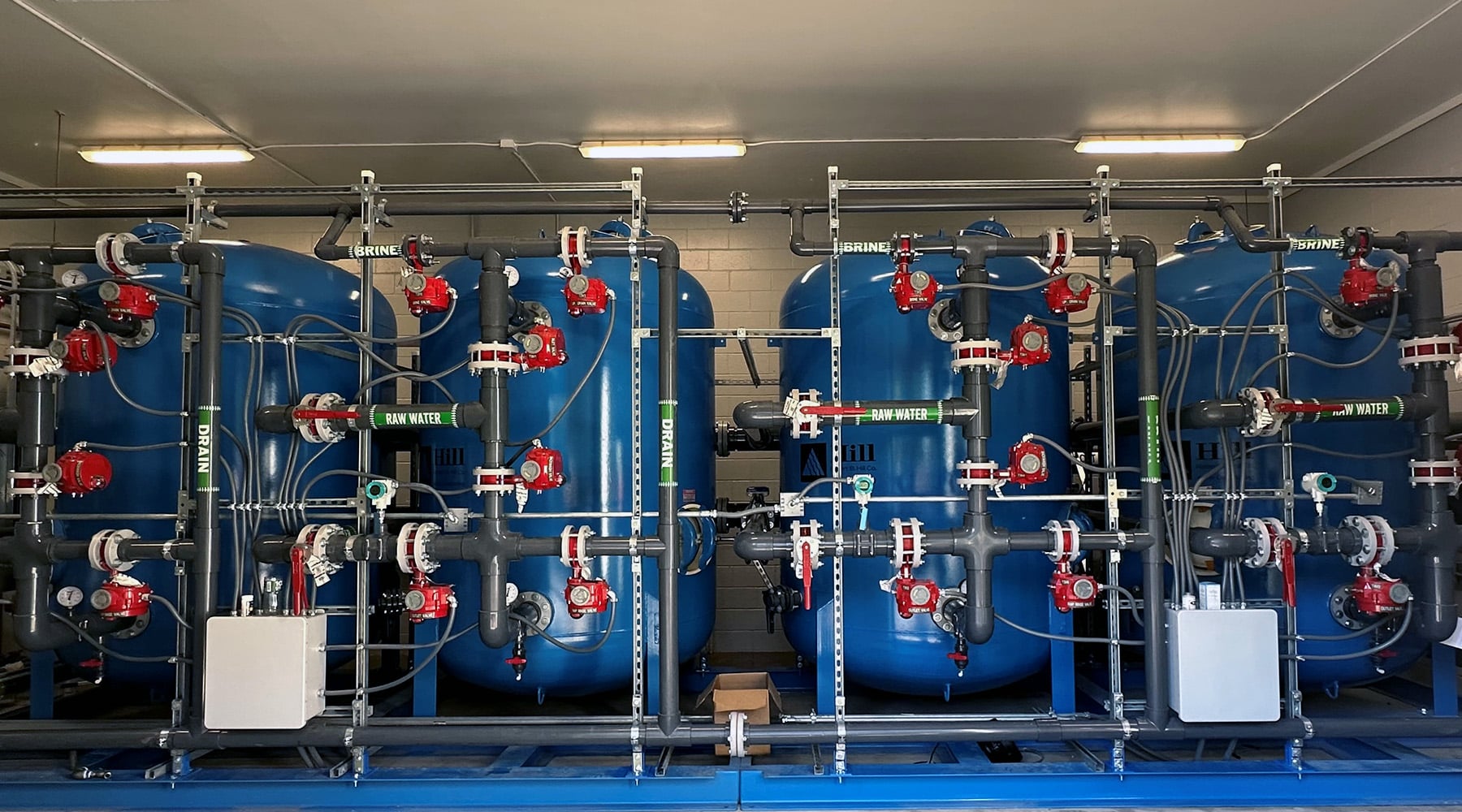
Water plays a much bigger role in business operations than most people realize. In a restaurant, it affects coffee, cooking, dishwashing, and ice. In a hotel, guests notice it in showers and drinking water. In a manufacturing facility, water may become part of a production process itself.
When the quality of that water isn’t quite right, the effects can spread quickly.
Scale can build up inside equipment. Sediment may clog components. Unpleasant tastes can affect food and beverages, while certain contaminants may create more serious operational concerns. And unlike a residential property, a commercial facility can use thousands of gallons of water in a normal day.
That’s why commercial water treatment needs a slightly different way of thinking. It’s not simply about choosing a filter and plugging it in. Capacity, flow rate, water chemistry, maintenance, operating costs, and reliability all matter.
Start With the Water, Not the Equipment
It sounds simple, but it’s an important point: test the water before choosing a treatment system.
A commercial facility may receive municipal water, well water, or water from another source. The characteristics can vary considerably. Hardness, iron, sediment, chlorine, dissolved solids, pH, and other factors can influence which treatment technology makes sense.
Water testing provides a baseline.
Without it, a business may spend money addressing the wrong problem. A system designed primarily for hard water won’t necessarily remove a particular dissolved contaminant, and a basic sediment filter won’t solve every taste or odor issue.
Good commercial water treatment begins with understanding what is actually in the water.
Hard Water Can Become an Expensive Nuisance
Hard water is common and contains minerals such as calcium and magnesium. In a commercial environment, however, the consequences can become more noticeable simply because equipment is used so frequently.
Coffee machines, boilers, dishwashers, water heaters, laundry equipment, and other appliances may encounter hard water every day.
Over time, scale can accumulate on heating surfaces and internal components. Cleaning may become more frequent, equipment performance can suffer, and maintenance costs may increase.
For facilities dealing with significant hardness, commercial water softeners can help reduce calcium and magnesium before the water reaches sensitive equipment.
The important part is sizing. A system designed for a small office won’t necessarily cope with the demand of a busy hotel or restaurant. Flow rate and peak usage should be considered, not just average daily consumption.
Filtration Depends on the Problem
The word “filtration” covers a surprisingly wide range of technologies.
A sediment filter might remove sand, rust, or other physical particles. Activated carbon can be useful for reducing chlorine and improving taste and odor. Specialized media can address particular contaminants.
For businesses, commercial water filtration systems need to be selected with both water quality and operating conditions in mind.
The system has to handle the required flow without creating unnecessary pressure loss. It also needs a practical maintenance schedule. A filter that performs brilliantly in a laboratory but requires constant attention during a busy workday isn’t necessarily a great commercial solution.
Reliability matters.
Reverse Osmosis Has a More Specialized Role
Reverse osmosis, commonly called RO, uses a semipermeable membrane to reduce many dissolved substances from water.
It’s particularly useful in applications where lower dissolved-solids water is desirable. Restaurants may use it for certain beverage or ice applications, while other businesses may require highly treated water for manufacturing or specialized processes.
A properly designed commercial reverse osmosis system can produce treated water at a much larger scale than typical residential equipment.
But RO comes with considerations. Membranes require protection from fouling, systems need appropriate pretreatment, and the process produces a concentrate or reject stream. Storage and delivery capacity may also matter when demand fluctuates throughout the day.
In other words, RO isn’t simply “install a membrane and forget about it.”
Think About Peak Demand
This is where commercial systems differ significantly from many residential setups.
A business may have relatively low water consumption for much of the day and then experience a sudden surge. A restaurant might use large quantities during meal preparation and cleanup. A hotel can see simultaneous demand from multiple rooms. A manufacturing facility may have specific production cycles.
The treatment system needs to keep up when demand is highest.
That’s why flow rate is just as important as daily capacity. A system that can treat enough water over 24 hours may still struggle if too much water is required during a short period.
Proper sizing should account for both average and peak demand.
Maintenance Should Fit Your Schedule
Nobody wants a water treatment system that becomes another operational headache.
Commercial facilities often run on tight schedules. Maintenance may need to happen outside operating hours, during planned shutdowns, or according to a regular service agreement.
Before selecting equipment, ask how often filters need changing, how frequently softener regeneration occurs, how membranes are maintained, and whether professional service is required.
Also consider access.
If a technician needs to dismantle half the equipment around the system just to replace a cartridge, routine maintenance can quickly become inconvenient.
A well-designed installation should make service as straightforward as possible.
Consider Operating Costs, Not Just Purchase Price
The initial equipment price is only one part of the financial picture.
Businesses should also consider water consumption, electricity, salt or regenerant use, replacement filters, membrane replacement, service, cleaning, and downtime.
A system with a slightly higher purchase price may prove more economical if it uses fewer consumables or requires less frequent maintenance.
Conversely, a sophisticated system isn’t automatically the most cost-effective option.
The right question isn’t, “What’s the cheapest system?”
It’s, “What system gives us the performance we need at a reasonable total operating cost?”
That’s a much better business question.
Protect the Equipment That Matters Most
Not every piece of equipment has the same water-quality requirements.
A commercial kitchen may have certain machines that are particularly sensitive to scale. A manufacturing process may have strict water specifications. An office may mainly care about drinking water taste.
Treatment can therefore be designed around the most important applications.
In some facilities, whole-building treatment makes sense. In others, it may be more efficient to provide specialized treatment at individual points of use.
There’s no rule saying every faucet has to receive exactly the same treatment.
Don’t Overlook Professional Design
Commercial water treatment is one of those areas where installation quality can matter almost as much as the equipment itself.
Incorrect sizing, poor plumbing, inadequate pretreatment, or insufficient storage can undermine an otherwise excellent system.
A knowledgeable provider should look at the water analysis, usage patterns, available space, drainage, pressure, and operational requirements before recommending equipment.
They should also explain what happens when something needs servicing.
If the answer is vague, keep asking questions.
A Long-Term Investment in Operations
Water treatment isn’t usually the most exciting item on a business budget. It doesn’t generate headlines or impress customers directly.
But reliable water can quietly support almost every part of an operation.
It can help reduce scale-related maintenance, protect sensitive equipment, improve the consistency of beverages and food preparation, and address specific water-quality concerns.
The smartest approach is to avoid treating commercial water treatment as a one-size-fits-all purchase.
Test the water. Understand the process. Calculate demand. Compare technologies. Consider maintenance and operating costs. Then choose equipment that fits the facility rather than trying to force the facility around the equipment.
Good water treatment should work in the background, reliably and predictably.
And when a system is doing its job properly, that’s exactly what a business wants — fewer surprises, fewer avoidable maintenance problems, and one less operational issue competing for attention during a busy day.